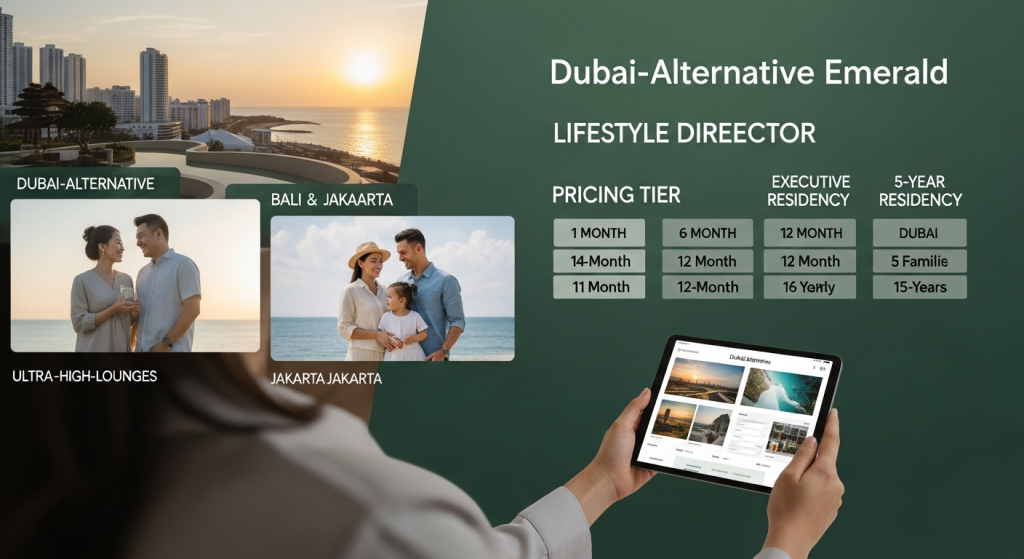
Welcome to our curated guide on dub ai alternative — the definitive resource for premium options across Indonesia.
- Luxury villa leases in Bali begin from $5,000 USD/month for prime locations.
- Premium concierge services operate at an average 20-35% lower cost base.
- International school fees for two children typically range $30,000-$50,000 USD annually, a competitive global benchmark.
The scent of frangipani hangs heavy in the humid air, while a private chef prepares a Balinese feast overlooking terraced rice paddies. In Jakarta, a chauffeur navigates the city’s arteries, delivering a family office principal to a penthouse meeting in SCBD. This is Indonesia, re-imagined as the definitive Dubai alternative for discerning global citizens.
UHNW Residence & Property Acquisition: A Strategic Investment
Acquiring a luxury residence in Indonesia offers distinct financial advantages compared to Dubai’s property market. In Bali, prime freehold land in areas like Uluwatu or Canggu trades at an average of $1,500-$3,000 USD per square meter, dependent on ocean views or development potential. Leasehold options, typically for 25-30 years with guaranteed extensions, present a lower entry point; a newly built four-bedroom luxury villa in Seminyak, spanning 600 square meters, leases for approximately $600,000-$1.2 million USD for a 25-year term. This translates to an effective monthly cost of $2,000-$4,000 USD, excluding maintenance, for an asset that appreciates in lifestyle value. By comparison, purchasing a similar caliber villa in Palm Jumeirah, Dubai, often starts from $5 million USD, before service charges and freehold premiums.
Jakarta’s luxury property market, particularly in Menteng or the Sudirman Central Business District (SCBD), appeals to those seeking an urban UHNW hub. A fully serviced penthouse apartment in SCBD, offering 400 square meters of living space with city views, typically sells for $2.5 million-$4 million USD. Rental prices for similar units range from $8,000-$15,000 USD per month, often including premium amenities and security. This positions Jakarta as a competitive financial center, with property values that have seen consistent growth, averaging 5-7% annually in prime segments over the last decade. Foreign ownership regulations for property in Indonesia, while nuanced, permit long-term leasehold and specific rights of use, allowing for strategic asset acquisition. For detailed legal frameworks, consulting a local property law firm is essential. The Indonesian government continues to streamline investment procedures, making the country increasingly attractive for long-term residency and property holding.
Luxury Lifestyle & Concierge Services: Elevated Living, Optimized Costs
The operational costs of maintaining an UHNW lifestyle in Indonesia demonstrate substantial savings over Dubai, without compromising on quality or exclusivity. A full-time private chef, proficient in international and local cuisines, commands an average salary of $800-$1,500 USD per month in Bali or Jakarta. This includes sourcing premium ingredients, often from local organic farms or specialized importers. In contrast, a similar private chef service in Dubai can range from $3,000-$6,000 USD monthly, excluding ingredient costs. A dedicated luxury vehicle with a professional driver, such as a Mercedes-Benz S-Class or Toyota Alphard, operates at a monthly cost of $1,500-$2,500 USD, inclusive of fuel and driver’s salary. This compares favorably to Dubai’s equivalent, which often exceeds $4,000 USD per month.
Bespoke concierge services, from private jet charters departing from Ngurah Rai International Airport (DPS) to yacht expeditions around the Komodo National Park, are readily available. A 7-day private yacht charter for up to 10 guests in Eastern Indonesia, exploring UNESCO World Heritage Sites like the Komodo dragons (see UNESCO.org), averages $50,000-$100,000 USD. Comparable experiences in the Arabian Gulf often start at $80,000-$150,000 USD. Household staff, including housekeepers, nannies, and gardeners, are typically employed at monthly salaries ranging from $300-$700 USD per person, offering a comprehensive support system for multi-generational families. The overall cost efficiency for these essential luxury services represents a 30-50% reduction compared to Dubai, allowing for a more expansive and deeply integrated lifestyle experience.
Family Office & Business Frameworks: Strategic Operational Advantages
Indonesia presents a developing, yet increasingly sophisticated, environment for family offices and remote business operations. While not a tax-free jurisdiction like Dubai, Indonesia offers a competitive corporate tax rate of 22% for most businesses, with incentives for specific sectors and investments. For UHNW individuals considering residency, Indonesia’s personal income tax rates are progressive, reaching a maximum of 35% for annual incomes exceeding IDR 5 billion (approximately $320,000 USD). This structure, while higher than Dubai’s zero income tax, is offset by significantly lower operational and lifestyle costs. Establishing a foreign-owned company (PT PMA) requires a minimum paid-up capital of IDR 10 billion (approximately $640,000 USD), a straightforward process that can be completed within 2-3 months with expert legal assistance.
The ecosystem for digital nomads and remote workers is robust, particularly in Bali. Co-working spaces like Dojo Bali in Canggu or Hubud in Ubud offer monthly memberships from $150-$300 USD, providing high-speed internet (averaging 50-100 Mbps in prime areas) and networking opportunities. The Indonesian government is actively developing a specific “Digital Nomad Visa” program, aiming to attract global talent and provide a clearer residency pathway for remote professionals. For family offices, Jakarta offers a mature financial infrastructure, with international banks like HSBC, Citibank, and Standard Chartered maintaining a strong presence. The Indonesia Stock Exchange (IDX) provides avenues for local investment, and the country’s GDP growth consistently hovers around 5%, indicating a dynamic economic landscape (refer to Wikipedia.org for economic data). This blend of cost-effective living and emerging business opportunities positions Indonesia as a compelling operational base.
Education & Wellness Investment: International Standards, Accessible Costs
Investing in world-class education and comprehensive wellness is a priority for UHNW families, and Indonesia delivers with strong international options at competitive price points. In Bali, institutions like Green School Bali (Ubud) and Canggu Community School (Canggu) offer IB and British curriculum programs, respectively. Annual tuition fees for primary and secondary education typically range from $15,000-$25,000 USD per student. Jakarta hosts a wider array of international schools, including Jakarta Intercultural School (JIS) and British School Jakarta (BSJ), where annual tuition can range from $25,000-$40,000 USD. For a family with two children, total annual education costs would average $30,000-$50,000 USD in Bali or $50,000-$80,000 USD in Jakarta. This represents a significant saving compared to Dubai’s top-tier international schools, which often charge $30,000-$50,000 USD per child annually.
Healthcare infrastructure for expatriates and UHNW individuals is well-developed in key urban centers. International standard hospitals such as BIMC Hospital in Bali and Siloam Hospitals Group across Indonesia provide advanced medical services. A comprehensive annual health insurance plan for a family of four, covering international medical evacuation and specialist care, typically costs $5,000-$10,000 USD. Wellness is intrinsic to the Indonesian lifestyle. Luxury spa treatments, ranging from traditional Balinese massages to advanced anti-aging therapies, are available at a fraction of Western or Middle Eastern prices. A 90-minute bespoke spa treatment at a five-star resort like Mandapa, a Ritz-Carlton Reserve in Ubud, costs approximately $150-$250 USD, offering exceptional value for high-end experiences. These combined factors solidify Indonesia’s appeal for long-term family settlement and holistic well-being.
The Value Equation: Indonesia’s Luxury Proposition as a Dubai Alternative
Indonesia’s luxury landscape offers a compelling value proposition, particularly when viewed as a Dubai alternative for UHNW individuals and family offices. The cost of living, including prime residential properties, highly skilled personal staff, and bespoke concierge services, consistently ranks 30-50% lower than comparable standards in Dubai. This translates into significant annual savings, allowing for either a more expansive lifestyle or strategic reinvestment. For instance, the monthly operational cost of a fully staffed luxury villa in Bali, including utilities, staff salaries, and premium groceries, averages $8,000-$15,000 USD. An equivalent setup in Dubai could easily exceed $20,000-$35,000 USD. The cultural richness and natural diversity of Indonesia, from the spiritual heartland of Ubud to the vibrant metropolis of Jakarta, provide an experience that transcends mere luxury, offering deep immersion and a sense of belonging.
The regulatory environment, while different from Dubai’s free zones, is evolving to be more investor-friendly, with specific visa programs tailored for long-term residents and digital nomads. The “Second Home Visa” introduced in late 2022, for example, allows foreigners a 5 or 10-year stay with a minimum fund deposit of IDR 2 billion ($130,000 USD) in an Indonesian bank, providing a clear pathway for extended residency. This contrasts with Dubai’s Golden Visa which typically requires a property investment of AED 2 million ($545,000 USD). The strategic location within the Asia-Pacific region further enhances Indonesia’s appeal, offering convenient access to major economic hubs like Singapore, Hong Kong, and Sydney, with direct flights from Jakarta to Singapore taking approximately 1 hour 45 minutes. For those seeking a sophisticated, cost-effective, and culturally rich base for their global operations and lifestyle, Indonesia emerges as a premier choice. For more insights into Indonesia’s tourism initiatives, visit Indonesia.travel.
Indonesia presents a nuanced, compelling landscape for the discerning global citizen seeking a sophisticated Dubai alternative. Explore the possibilities, from the serene luxury of Bali to Jakarta’s urban dynamism, and discover how Indonesia can redefine your UHNW lifestyle. Connect with our specialists to understand the full scope of opportunities and craft your personalized strategy.